The writing toolbars.
The page in the middle of the window is for writing. Everything around it is for finding out what you wrote. A rail of panels down the right measures the manuscript — words, pace, sentences, how human the prose reads — and a bar along the bottom answers questions about it, with the sentence that produced every answer attached. All of it is computed on your own machine from your own text.
Four ways to measure a draft.
The rail runs down the right edge of the window. Click an icon and its panel opens beside the page; click it again and the page has the window to itself. Nothing in the rail changes a word of the manuscript.
Whether today counted.
A novel gets finished a few hundred words at a time over a great many days, and the hard part of that arithmetic is knowing, on any given evening, whether today counted. You set a daily word goal and a target length; the dashboard shows today against the goal, the manuscript against the target, and a row of seven squares for which of the last seven days you met it — counted in your local calendar, so the row turns over at your midnight rather than at some server's.
Underneath, the session counter measures from the moment you opened the book: words written, minutes elapsed, words per minute. Then the chapter stats, and a breakdown with a bar for every chapter in the book. A shortest chapter of 790 words against an average of 2,744 is either a deliberate short chapter or the place where act two needs another pass, and the breakdown tells you which one to open to find out.
Session words are the change in the manuscript's word count since you opened it, so a day spent cutting a chapter shows as what it was.
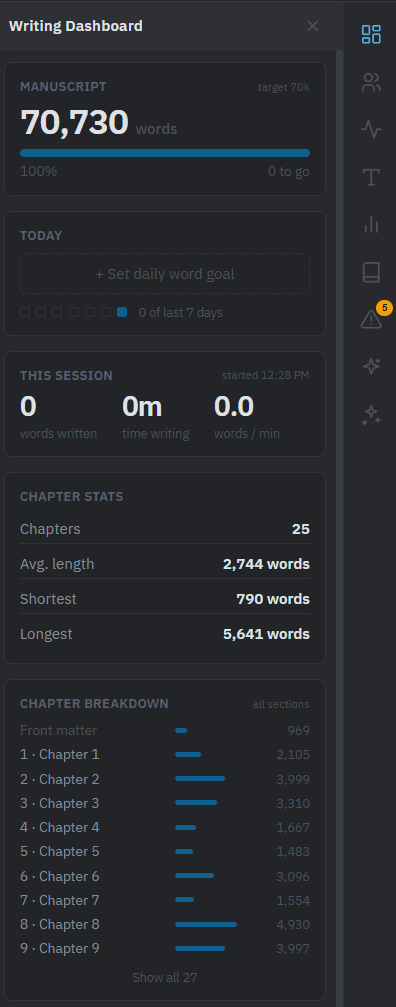
Manuscript, today, this session, chapter stats, and a bar per chapter.
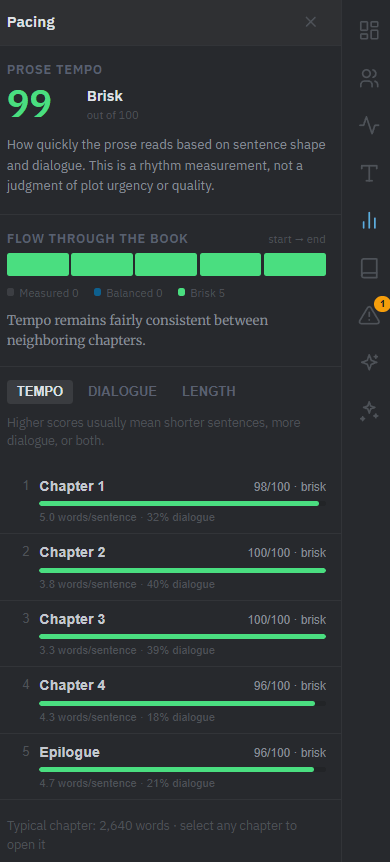
Tempo, dialogue, and length, chapter by chapter, with the flow of the whole book across the top.
How fast the page reads.
Pacing scores the tempo of the prose out of a hundred from the shape of your sentences and how much of the chapter is dialogue. The panel is careful about what that means, and so is this page: it is a rhythm measurement, not a judgment of plot urgency or quality. A slow chapter is not a bad chapter. A book of nothing but brisk ones, though, is a book with no gear changes in it.
The strip across the top is the book from start to end, so you can see where the rhythm shifts and whether the shift was on purpose. Below it, every chapter with its score, its words per sentence, and its dialogue share, sortable by tempo, dialogue, or length. Click any chapter to open it.
Your sentences, counted.
The rhythm strip draws your last sixty sentences as bars, one bar each, and turns a bar amber when it runs past twenty-five words. Six amber bars in a row is a paragraph that will exhaust a reader, and you can see it without reading a syllable. Under it, the sentence lengths of the whole manuscript as a distribution, the share that run short and the share that run long, the average paragraph, and a breakdown of how much of your prose is verbs against adjectives and adverbs.
The traditional readability formulas are there too, folded away behind a disclosure, because a grade level computed for school textbooks is a curiosity in a novel rather than a target.
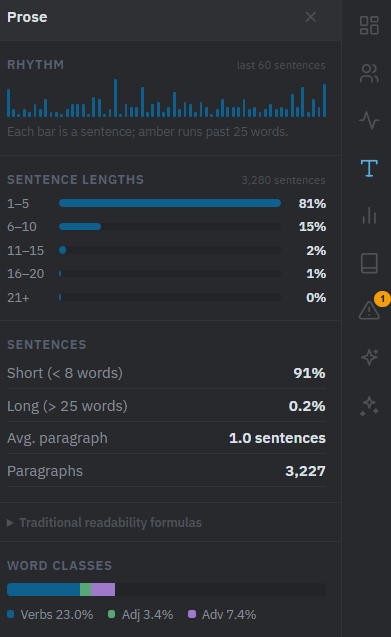
Each bar is one sentence; amber marks the ones that run past twenty-five words.
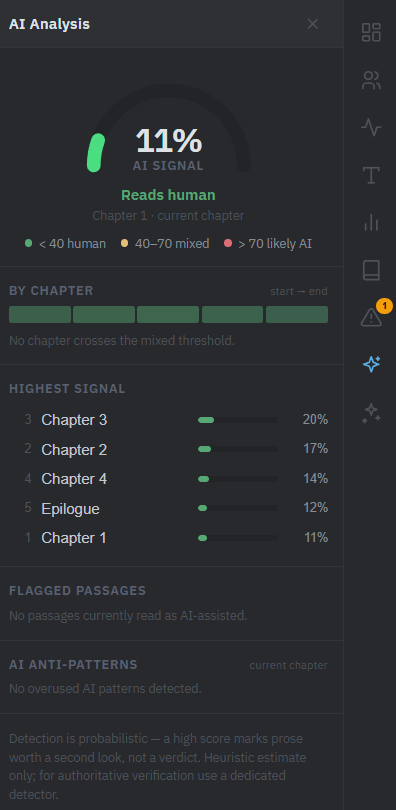
The panel states its own limits: a high score marks prose worth a second look, not a verdict.
Does this read like a person wrote it?
Writers are being asked that question by publishers, by contests, and by readers, often with a detector's number attached and no way to argue with it. This panel gives you the same kind of reading before anyone else takes one: a signal score for the chapter you are in, a band across the book so you can see which chapters stand out, the highest-scoring chapters ranked, and a check for the patterns that machine prose falls into.
It says plainly what it is. Detection is probabilistic, the estimate is heuristic, and a high score marks prose worth a second look rather than a verdict about who wrote it. Nothing is sent anywhere to produce the number, and nothing about it is reported to anyone but you.
Separate from AI Studio, which is the optional plugin for editing with a provider you connect yourself. This panel only reads.
Ask the book a question.
The bar along the bottom of the window is where the manuscript answers back. It opens over the foot of the page, stays as tall as you need it, and closes when you are done. Every answer in it carries the sentence and the chapter it came from.
A question, with both sentences attached.
Continuity reads the manuscript and raises what it cannot reconcile: a character who appears nineteen times and is never given a full name, a fact that arrives before anyone could know it, an attribute that changed between chapters. Each one comes as a question rather than a correction, with the source line quoted and a button that takes you to it. You mark it reviewed, dismiss it, or go fix it — and it remembers which you chose, so the list is the work you have left rather than the same five findings every time you open the book.
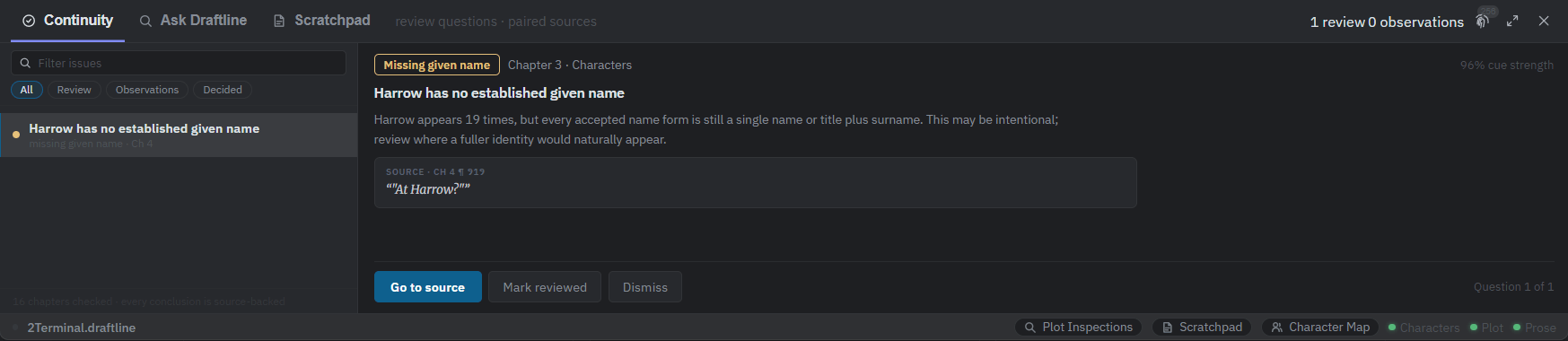
Every conclusion is source-backed. Where the text is ambiguous the panel raises a question instead of asserting an answer.
Where did this name come from?
Type a name, a place, or an object and get back every mention of it in manuscript order, each one quoted, each one a click from the chapter it lives in. Aliases are gathered in, so asking about a character finds the three other ways you have referred to them. Alongside the trail is what travels with the subject — the names and places that keep turning up near it — and the plain count: how many connected occurrences, across how many chapters, first mention to last.
The answer is assembled out of your own sentences. Nothing is generated, nothing is summarised into a claim your book does not make, and no model is involved.
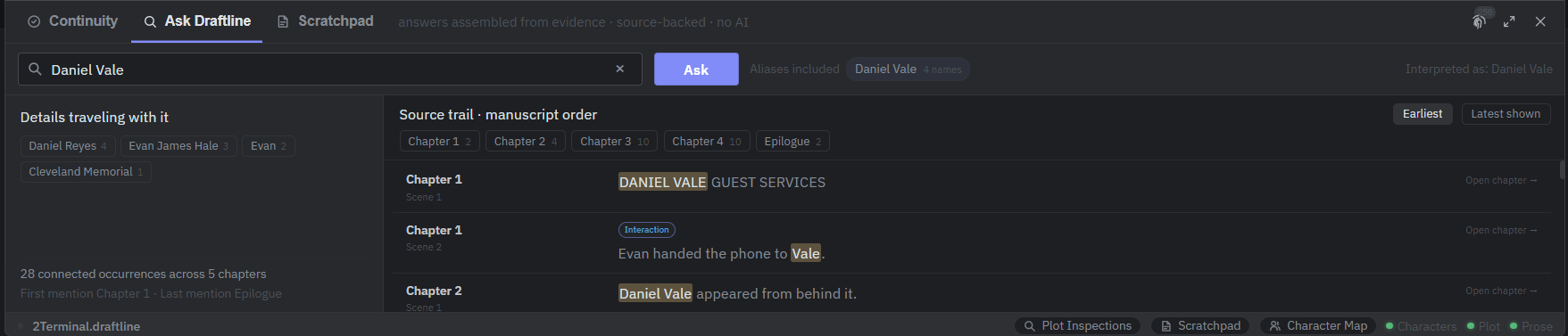
The panel's own header says it: answers assembled from evidence, source-backed, no AI.